

I appreciate you visiting the second installment of my Scarcity series. Here goes.
I returned from my shenanigans in Lagos a month and a half ago, and I needed time to decompress and think before sharing my not-so-short stories. What I experienced in the old country left me inspired yet soured at the same time. I wanted to share the things I saw—not because they can be fixed, but because they felt integral to the shared human experience.
MM2
Mumsy, my younger sister Sunshine (22), and I left for Lagos on December 7th and arrived the following evening at about 6:30. Seeing shege (pronounced “shay-gay”), or encountering stress, starts as soon as you get off the plane. The terminal and passport check lines at Murtala Muhammed were relatively orderly this time around. Then came the delays at baggage claim. It took us an hour and a half to get all the bags, six 50-pound suitcases. Stepdad met up with us at the front. It was comforting to see a warm, familiar face. He had organized two cars to pick us up at the entrance. Absolute chaos ensued. Hundreds of people were coming and going, shouting and shoving past each other. Cars lurched into the crowd with impunity.
Taxi men asked “Madam, where you dey go?”, gesturing to take your luggage with them and deliver you at your destination.
Malams, or money-changers, shouted “Buy dolla! Buy dolla!” to ensnare you with their exchange rates.
“Excizz please” as those with trollies full of bags tried, but failed, to gently shift around you.
Arguments in different tongues, some of which I could understand. But even for the ones I couldn’t, it was clear that frustrations were high and there was no time to waste, for another international flight was set to land soon, creating even more disarray. This took another hour at the least, an interesting genesis to our trip. Thankfully, we got out of there before the next flight arrived. In a functional society, where an airport is considered a nation’s “face in front of the world”, things would be organized, no?
Nights Out
My nights out in Lag taught me what scarcity causes some to do, and how survival looks different for everyone.
We started off getting drinks at a lounge on a Thursday night. Relatively chill. Sunshine and I went to the restroom and found three girls undressing in front of the mirror. One of the girls’ breasts became exposed, and there was no element of shock to her face. No awkward “oops” or anything. Not even briefly. She didn’t care that I saw. Undressing outside the stalls seemed normal to them. As we used the facilities, I could hear them speaking among themselves. It sounded blank and routine. Just another Thursday night. “Wear this”, “fix that”. Not an atom of rebellion or fun. As we washed our hands, I saw that they had changed into their club clothes and started fixing their hair and makeup. There was no sense of ease, only urgency. Like they were in a rush to go back out. There was something different about these girls. Sunshine and I felt it, but couldn’t voice it. This was not your standard unconcerned girls night out.
The next night, Sunshine and I opted for the proper Detty December experience. We planned to stay on the mainland, not far from the hotel. The first location was not special. Men moved about with their women to and fro. Girls stood aimlessly outside in wait. The second was down the street and around the corner. As we entered, the bouncer saw a bundle of cash in my purse, perhaps around 60,000 naira. He stylishly asked for money, to which I obliged. When we got settled inside, I observed different varieties of women. Light, dark, slim, curvy, BBLs, natural, and everything in between. Surely, it would be unwise to assume that these were working girls, but there is an underlying tone in Lagos: it is expected for women to commodify sexuality in order to get by. “Getting by” can be as simple as a night out handled exclusively by the men in your party, or as weighty as your survival and maintaining your lifestyle. Although I say this from a place of objective privilege and the Lagosian hotties would probably think I’m doing too much, I truly see something insidious in that. It feels parasitic in both directions.
We left the second venue forty-five minutes in. At the entrance, we passed a group of at least eight men at the gate, sitting in wait for passersby and gisting among themselves. I mistakenly let my eyes linger for a split-second too long. One of them was a middle-aged man, bound to a wheelchair.
“Mama, anything for us?” They were older than me, yet calling me “mama”, so I knew what it was.
I opened my bag and struggled to remove some bills from the cash that I had. It was still in bands. I was only interested in giving some to the man in the wheelchair, but I was starting to bring unnecessary attention to myself with the struggle, so I walked away. Not because I wanted to, but because the men made me anxious. And for good reason. In an instant, the men rushed us as we walked to the car, wheeling the man over. I pulled out a small wad and handed it to him. I didn’t get to count it, but it was something.
“God bless you.”
“Thank you. It’s ok.”
The voices of the others echoed as they begged. They didn’t impede us from entering the car, but they didn’t make it easy to leave either. I simply couldn’t help everyone. We pulled off and headed to Victoria Island next although we promised Stepdad we would remain on the mainland. That wasn’t my fault. I sat in the car reliving what just happened. Men of various ages, some able-bodied and some infirm, waited outside the clubs at 2 AM to beg for money. Is this the state we’ve reached? Nigerians are a proud people and aren’t averse to hard work. Seeing these men this way was pitiful.
On VI at 3 AM, we could see all manners of people. Top boys and girls in Bentleys, G-Wagons, Maseratis, among other brands. In between these machines, little heads bobbed in and out of traffic. Children following their mothers to beg. Some mothers had babies with them. The disparity was glaring. Here we all were, trying to live it up and Detty December while women and children lay in wait hoping to get the dregs of our intoxicated goodwill. It felt like sin. When the night reached its close, it was a quarter past 5.
Sidenote: If you think you like to party, no you don’t. Lagos is a different level of outside that I’ve never experienced before. These people don’t go home. In New York, most spots will close promptly at 2 AM. In Lagos, they will very well stay out till 6 going between several locations. Lag taught me that I can’t hang.
I caught sight of a little boy of about ten or eleven years. He caught sight of me, too.
“God bless you ma. Will you do Christmas for me?”
I knew I was going to give him something, but I walked quietly. He followed and kept asking. I entered the car and rolled down the window.
“Shhh.” I handed him around 10K.
I didn’t shush him because I felt he wasn’t important. I was nervous about another swarm of people coming over that I couldn’t take care of.
“Thank you. God bless you.”, and he gleefully ran off.
I knew it wouldn’t change his life, but seeing a kid be a kid soothed something in me.
I was always aware that things weren’t as pretty as they seemed in Lagos, but the nights out showed me that scarcity is the greatest humbler and that everyone is getting used to “get by” in one way or another.
Where everything is cheap, even life itself.
Definitions of what “normal” looks like vary widely from place to place. Back home, disorganization and the danger that it causes was all too commonplace.
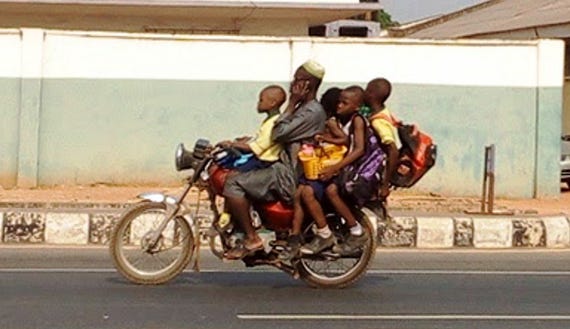
During a day trip in Abeokuta, we navigated bustling streets where four lanes turned into seven and bodies wove in and out like a coordinated game of double-dutch. I observed these bodies as they moved. I saw a beautiful woman on an okada—a motorcycle used for paid transportation— with her children. It was the okada-man, a child, I believe a second, and then herself. She had a moon face, and a rounded, womanly figure. Reminiscent of a favored artist of mine, Nelly Uchendu. Dark, soft curls that bellowed in the wind as they sped by. Dramatic jet black eyeliner. And red lipstick. I hope she and her children make it. I later saw two young boys, no more than nine or ten, running through several lanes of whizzing traffic, laughing to themselves. Carefree. Finding joy in the sporadic and almost fearless. I hope they make it, too. As much as we want to wag our fingers at mothers putting children in unsafe positions or children playing in traffic, this all stems from scarcity. It’s easy to say “it could never be me”, but we haven’t stopped to ask what each of us would do to survive.

The Friday evening before leaving Lagos, we journeyed on a tight Ikeja roadway— a supposed shortcut. On the left, a small crowd of about 15 to 20 men gathered on worn, woven mats of varied hues. They kneeled, they bowed, and they stood towards the east, softly clutching their beads in prayer. A charter bus cut into the street, almost hitting them. Followed by another truck. Then a woman in a sedan. Their lackadaisical attitude towards safety prevailed. They didn’t care for others or even themselves. They just had to be the first. “If they get theirs, then I can’t get mine. So fuck them,” is the underlying thought process here. Countless lives have been needlessly lost over the years due to the “me first” and “I’m more important” attitude. I can’t fully blame people for behaving this way when their corrupt government has shown them that they are disposable and insignificant, failing to provide reliable systems and infrastructure since the nation’s birth. So yea, on a human level, I get it.
But fuck, do we have to make it worse?
Survival isn’t a pretty exercise anywhere you go.